


Almost everyone at your company is already using AI. Almost no one has been taught how. In Australia, 84% of workers now use at least one AI tool on the job - but only 7% have reached an advanced level of skill with it. Everyone else is teaching themselves in the dark, and it's quietly costing the country billions.
Adoption isn't the problem anymore. Competence is.

The beginner tax is real
RMIT Online and Deloitte Access Economics put a number on the gap between how much Australians use AI and how well they use it: roughly $18.9 billion in lost economic growth. More than half of workers (54%) are stuck at beginner level, and only about half get any AI training from their employer at all. Everyone's driving; almost no one's had a lesson.
"Using it" and "being good at it" are not the same thing
There's a comfortable myth going around: because staff picked up ChatGPT on their own, the AI box is ticked. It isn't. Self-taught, unsupervised "shadow AI" gets you surface-level wins and a long tail of risk - outputs trusted blindly, sensitive data pasted into the wrong tool, and no one able to tell a good result from a plausible-looking bad one. The data exposure side of that is the same problem we set out in seven remote work cybersecurity practices. The workers charging ahead are now ahead of their own leaders, who a recent Microsoft study found are the ones falling behind. It is the same skills-gap pressure we covered in six ways to bridge the tech skills gap.
What "knowing how" actually looks like
We didn't have to look far for proof. Chel, our Payroll Practice Manager, went from never having heard the term "prompt engineering" to running an entire payroll function with AI. Validations that used to eat half a day - sometimes a full day - now come back in minutes. It's caught overtime errors that would have underpaid staff. She calls it "a little Einstein."
But here's the part that matters: it works because she's an expert who learned to direct it - check its sources, correct it when it's wrong -not because she handed her job to a chatbot. That's the whole difference between using AI and knowing how.

A one-off workshop won't fix it
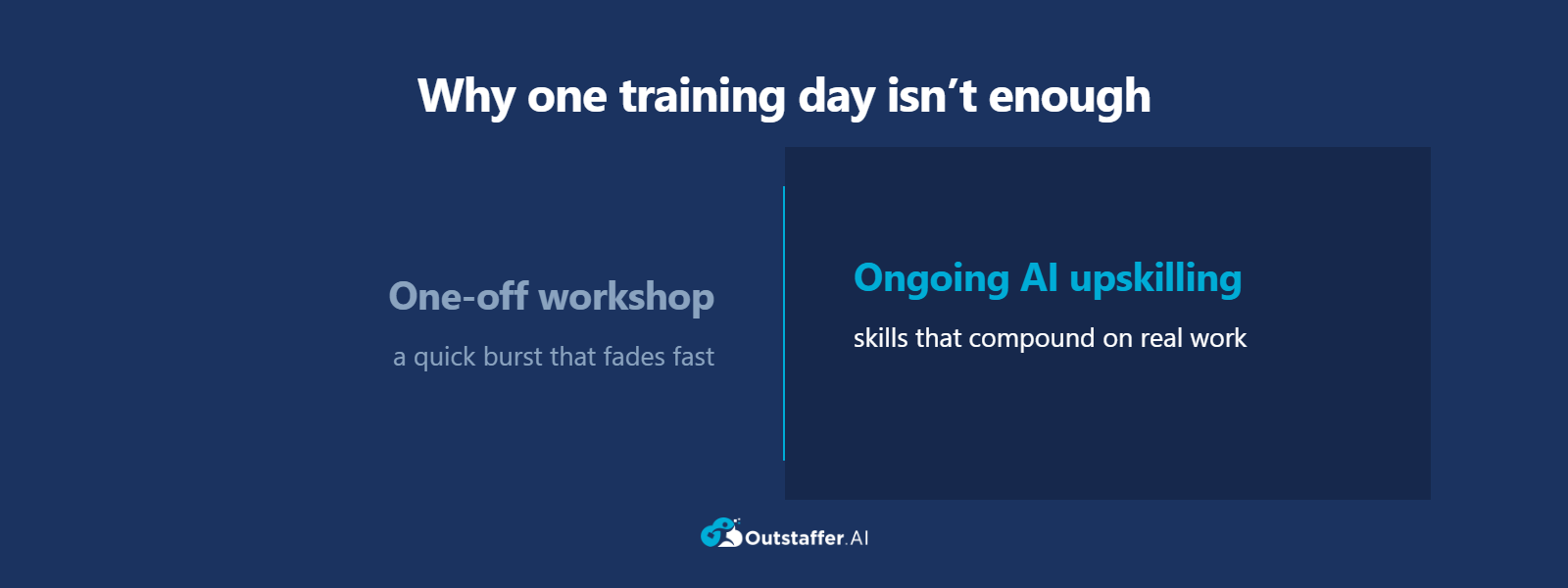
The instinct is to book a training day and call it done. It doesn't stick. We watched an accounting practice spend $5,000 bringing consultants in for a workshop - the quick burst barely moved the needle. AI moves too fast for one-and-done. Skills have to be built continuously, the way Chel built hers: a bit at a time, on real work, with support when she got stuck. We set out how to run that properly in a practical starting point for upskilling your team.
This is why we don't just employ
It's why we've changed how we think about hiring. If the gap is too wide to train your way out of, the choice becomes hiring the skills or building them, and the wider version of that decision sits in upskill, outsource or hire. Recruiting the right person is step one. Employing them properly is step two. But the real advantage in 2026 is step three: equipping and upskilling them with AI so they become the best version of themselves at their craft. That's how one expert ends up with the output of a whole team - and it's what we now build in for the people we employ, and their clients' teams too.
Ready to build an AI-enabled team?
Outstaffer helps you recruit, employ, equip and upskill your team - with AI - across the Philippines, Vietnam, Malaysia, Thailand, Singapore, New Zealand and Australia. Your first hire is on us.
More from
Global Hiring
category





%201.svg)
