
Hire employees and contractors in Spain
Outstaffer’s guide to employing in Spain.
Facts & stats
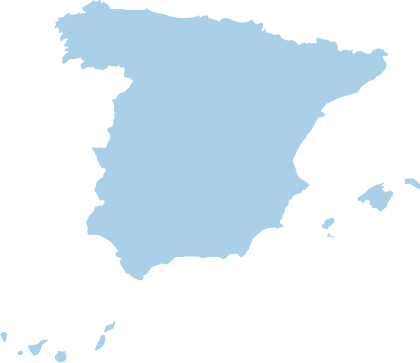
Spain (Spanish: España), officially the Kingdom of Spain (Spanish: Reino de España), is a country in Southwestern Europe with some pockets of territory across the Strait of Gibraltar and the Atlantic Ocean. Spain is a secular parliamentary democracy and a parliamentary monarchy, with King Felipe VI as head of state. It is a major developed country and a high income country, with the world’s fourteenth-largest economy by nominal GDP and the sixteenth-largest by PPP.
- Capital city
- Madrid
- Currency
- Euro (€, EUR)
- Official Languages
- Spanish, Catalan, Basque, Galician
- Population size
- 47,329,981 (2020 est.)
- Ease of doing business
- Very Easy
- Cost of living index
- $$$ (44 of 139 nations)
- Payroll frequency
- Monthly
- VAT - standard rate
- 21%
- GDP - real growth rate
- 2.582% (2018 est.)
Tech Talent in Spain
Spain has emerged as a notable hub for tech talent in Europe. The country boasts a growing community of skilled software developers, engineers, and IT professionals. Spanish universities produce graduates with strong technical expertise, and cities like Barcelona and Madrid are witnessing a surge in tech startups and innovation hubs. Spain's vibrant lifestyle, coupled with a relatively lower cost of living compared to some other European tech hubs, makes it an attractive destination for tech companies and entrepreneurs. Spanish tech talent is known for its creativity and adaptability, contributing to the country's growing presence in the global tech landscape.
Grow your team in Spain with Outstaffer
Looking to employ workers in Spain? Companies hiring in Spain must either own a legal entity in the country or work with a global employment solutions provider, usually one that provides employer of record services.
Outstaffer can employ your team in Spain on your behalf through our local legal entity in the country and handle payroll, benefits, taxes, and compliance for your Spain team. You can also pay contractors now in Spain with us.
Minimum wage
€1,125.80 per month in 12 payments.
Payroll cycle
All employee payments are made bi-monthly by Outstaffer.com on your behalf and passed through to you.
Onboarding time
We can help you get a new employee started in Australia fast. The minimum onboarding time we need is only 14 working days.
Our team ensures your employees are onboarded and paid as quickly as possible while keeping your business compliant with all local employment legislation. The minimum onboarding time begins after the employee submits all required information onto the platform. The onboarding timeline is also dependent upon registration with local authorities.
For all non-nationals of the country of employment, the Right to Work assessment (if applicable) will add three extra days to the total time to onboard. There may be extra time required if we need to follow-up on the right to work assessment.
Please note, payroll cut-off dates can impact the actual first day of employment. Outstaffer has a payroll cut-off date of the 10th of the month unless otherwise specified.

Employing in Spain
Employment law in Spain is not contained under a single law. Instead it is governed by statutory regulations codified in (among other laws) the Spanish Civil Code and the Spanish Workers' Statute. The Spanish Workers' Statute regulates legal and regulatory of Spain, the will of parties intended in employment contracts, local and professional customs and practices as well as collective bargaining agreements.
Spanish employment law provides strong labor conditions and protections for employees, so employing people will generally be an important investment and commitment.
Temporary agencies are popular options for more flexible workforce arrangements. For these and many other reasons, the following are only guidelines in the broadest sense, and professional legal services are recommended when employing in Spain.
Risks of misclassification
Public holidays
Jan 6
Epiphany Day (Epifania del Señor)
Aug 15
Assumption of Mary (Asunción de la Virgen)
Dec 6
Constitution day (Día de la Constitución Española)
Apr 7
Epiphany Day (Epifania del Señor)
Oct 12
Spanish National Day (Fiesta Nacional de España)
Dec 8
Immaculate Conception (Inmaculada Concepción)
May 1
Labor Day (Fiesta del Trabajo)
Nov 1
All Saints Day (Todos los Santos)
Dec 25
Christmas Day (Natividad del Señor)
Competitive benefits package in Spain
Beyond providing your employees with all statutory benefits, Outstaffer can help you create a custom benefits package for your international team. A competitive benefits package may include perks such as:
 Private health insurance
 Supplemental dental insurance
 Supplementary vision insurance
 Supplemental maternity insurance
 Supplemental screening & vaccine insurance
 Additional paid holidays
 Flexible work schedule
 Employee engagement funds
Taxes in Spain
Learn how employment taxes and statutory fees affect your payroll and your employees’ paychecks in Spain.
Employer Social Security Contributions (31.55%)
- Employer Social Security contributions are capped monthly on a base of EUR 4139.40
- 23.60% - Common Contingencies
- 5.5% - Unemployment for permanent employees (or 6.70% for temporary employees)
- 1.65% - Occupational accident and professional disease contribution
- 0.6% - Professional Training
- 0.2% - Wage Guarantee Fund
Employee
- 6.35% - Social Security
- 1.55% - Unemployment
- 0.1% - Professional Training
Employee Income taxes
- 19% - Up to 12,450
- 24% - 12,451 - 20,200
- 30% - 20,201 - 35,200
- 37% - 35,201 - 60,000
- 45% - Above 60,000
Types of leave
Statutory leave
All full-time workers are legally entitled to 23 days paid holiday leave a year. In addition, full-time workers have 14 paid public holidays a year.
Maternity leave
Maternity leave is 16 weeks for Spanish employees. At least six uninterrupted weeks must be taken immediately following the birth. Four of these weeks can be taken leading up to the birth. During the maternity period, workers are not paid a salary but instead a maternity benefit. This contribution is paid directly from the Social Security Administration to the employee. Women have the right to one hour of absence from work each day to breastfeed an infant of less than nine months. The employee can also choose to accumulate these hours, and take off 15 consecutive natural days after the maternity leave instead.
Paid parental and maternity leave
Salaried employees in Australia are entitled to four weeks of paid annual leave each year. Shift workers receive an additional week of paid leave, for a total of five weeks per year.
Parental and paternal leave
In Spain, 16 weeks of paternity leave is also available. The first six weeks have to be taken immediately without interruption (starting on the day of birth of the child). The other 10 weeks must be taken before the child is one year old. This leave must be taken in batches of one week as a minimum, but the weeks can be split over time if desired. The employee receives 100% pay during this time (as long as payment does not exceed 4070.10 EUR). The father is also entitled to take unpaid childcare leave until the child is three years old.
Parental leave
Salaried employees in Australia are entitled to four weeks of paid annual leave each year. Shift workers receive an additional week of paid leave, for a total of five weeks per year.
Breastfeeding leave
Parents can take an additional breastfeeding leave after parental leave. This breastfeeding leave can be enjoyed in two ways:
- take one hour off during the day, until the child is nine months old (it can either be one hour, or half an hour at the beginning and at the end of the working day)
- take 15 consecutive natural days after the parental leave
The breastfeeding leave is considered as working time, meaning that the employee doesn't receive anything from Social Security and is paid by the company at 100%.
Other leave
- Adoption: upon adoption of a child or have taken in a foster child, employees are entitled to the same entitles apply as for maternity and paternity rights. Applies to both parents.
- Emergency and short absence leave: intended for unforeseen personal circumstances for which an employee has to take time off immediately. Examples include making arrangements for the care of a sick family member or in the event of a death in the family. Up to two calendar days or four if travel is required.
- Time off work for public duties: intended for allowing employees to fulfill certain public duties related to roles such as local councillors, school governors, trade union member, etc.
- Long-term care leave: when a child, partner or parent of the employee is seriously (i.e. life threateningly) ill and requires care, the employee can request long-term care leave.
- Unpaid leave: the employee may take unpaid leave in consultation with the employer on a full-time or part-time basis. Granted at the discretion of the employer, but must always be set in an individual or collective agreement. Unpaid leave periods are not regulated by law.
Employment termination
Termination process
Spanish employers in general can provide any fair reasons for termination of an employee. Any dismissal from the end of the employer for an employee that has been employed longer than six months has to be "socially justified" by the following:
- Dismissal of the employee without notice for disciplinary reasons, for example in case of theft or any other serious misconduct;
- Ordinary dismissal with notice based on economic factors related to production, the organisation of work, the proper functioning of the business and redundancy; or
Notice period
The statutory notice period for an employer depends on the reason for dismissal and the collective bargaining agreement the employment contract is subject to. For dismissals due to economic factors related to production, the organisation of work, the proper functioning of the business and structural, the company has to provide 15 days prior notice. Employees are generally required to provide 2-3 weeks of prior notice when resigning, depending on the collective bargaining agreements.
Probation periods
The establishment of a probationary period is not mandatory under Spanish labor legislation. The applicable CBA includes the maximum probationary periods to be agreed with the employees. It is feasible that for the same professional category, you agree different probationary periods with employees if there is justified reason (as a matter of example: experience, training, languages, etc.) and provided that you respect the probationary periods limits established in the CBA.
Get started with Outstaffer in three easy steps

01. Book a call or sign up
Book a call with one of our Solutions Managers or create your free account. It’s quick, easy, and you’ll be ready to get started in minutes.
02. Add your people
From new hires to your existing team, onboard them seamlessly with our simple-to-use self-serve platform
03. Dedicated onboarding
Our dedicated team is here to guide you every step of the way ensuring you’re confident, supported, and set up for success.