
Hire employees and contractors in Portugal
Outstaffer’s guide to employing in Portugal.
Facts & stats
Portugal, officially the Portuguese Republic (Portuguese: República Portuguesa) is a country located mostly on the Iberian Peninsula, in southwestern Europe. It is the westernmost sovereign state of mainland Europe, being bordered to the west and south by the Atlantic Ocean and to the north and east by Spain. Its territory also includes the Atlantic archipelagos of the Azores and Madeira, both autonomous regions with their own regional governments.
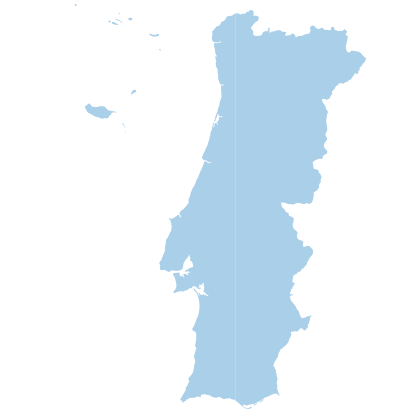
- Capital city
- Lisbon
- Currency
- Euro (€, EUR)
- Official Languages
- Portuguese
- Population size
- 10,276,617 (est. 2018)
- Ease of doing business
- Very Easy
- Cost of living index
- $$$ (56 of 139 nations)
- Payroll frequency
- Monthly
- VAT - standard rate
- 23%
- GDP - real growth rate
- 2.145% (2018 est.)
Tech Talent in Portugal
Portugal is increasingly becoming a hotspot for tech talent in Europe. The country boasts a growing community of skilled software developers, engineers, and IT professionals. Portuguese universities provide a strong foundation in technology and engineering, while a relatively low cost of living and a vibrant lifestyle make it an appealing destination for tech companies and startups. Lisbon and Porto, in particular, are emerging as thriving tech hubs, fostering innovation and entrepreneurship. Portuguese tech talent is recognized for its adaptability and multicultural perspective, contributing to Portugal's rising presence in the global tech industry.
Grow your team in Portugal with Outstaffer
Looking to employ workers in Portugal? Companies hiring in Portugal must either own a legal entity in the country or work with a global employment solutions provider, usually one that provides employer of record services.
Outstaffer can employ your team in Portugal on your behalf through our local legal entity in the country and handle payroll, benefits, taxes, and compliance for your Spain team. You can also pay contractors now in Kenya with Outstaffer.
Minimum wage
Minimum Wage: €760 per month in 14 payments for all employees.
Payroll cycle
All employee payments will be made in equal monthly installments on or before the last working day of each calendar month, payable in arrears.
In Portugal, employees get 14 months of salary payments each year:
- 12 months of work
- 1 Holiday allowance
- 1 Christmas allowance
The allowances are paid with the same amount as a full month's salary.
Both the Subsídio de Férias (Holiday Allowance) and the Subsídio de Natal (Christmas Allowance) get taxed the same as any other payment for IRS & Social Security.
Employees can choose to earn their salary in 14 payments, with the holiday allowance being paid during Summer and the Christmas allowance being paid around the Christmas period.
Conversely, workers can elect to be paid 12 times ("duodécimos"), with those two extra payments being pro-rated throughout the year.
The payments have to be paid at least once a month and by the last working day. At Outstaffer, this payment is made on the 25th of the month.
Onboarding time
Our team ensures your employees are onboarded and paid as quickly as possible while keeping your business compliant with all local employment legislation. The minimum onboarding time begins after the employee submits all required information onto the platform. The onboarding timeline is also dependent upon registration with local authorities.
For all non-nationals of the country of employment, the Right to Work assessment (if applicable) will add three extra days to the total time to onboard. There may be extra time required if we need to follow-up on the right to work assessment.
Please note, payroll cut-off dates can impact the actual first day of employment. Outstaffer has a payroll cut-off date of the 10th of the month unless otherwise specified.

Employing in Portugal
Portuguese labour law is not contained under a single law. The main sources are the Portuguese Constitution which sets forth fundamental rights and principles regarding both employees and employers, European legislation, the Portuguese Employment Code and the Regulation of the Employment Code. Furthermore, collective bargaining agreements as well as individual agreements also play a role.
The vast majority of rules stipulated by the Portuguese Employment Code are mandatory and cannot be modified either by collective bargaining or agreement of the parties. All workers in Portugal are protected by Portuguese employment law.
Risks of misclassification
Public holidays
Jan 1
New Year's Day (Dia de Ano Novo)
Jun 8
Corpus Christi (Corpo de Deus)
Dec 1
Restoration of Independence Day (Restauração de Independência)
Apr 7
Good Friday (Sexta-feira Santa)
Jun 10
Portugal Day (Dia de Portugal)
Dec 8
Immaculate Day (Dia da Imaculada Conceição)
Apr 9
Easter Sunday (Páscoa)
Aug 15
Assumption Day of Our Lady (Assunção de N.a Senhora)
Dec 25
Christmas Day (Natal)
Apr 25
Freedom Day (Dia da Liberdade)
Oct 5
Implantation of the Republic (Implantação da República)
May 1
Labor Day (Dia do Trabalhador)
Nov 1
All Saints Day (Dia de Todos os Santos)
Competitive benefits package in Portugal
Outstaffer supports our clients by offering competitive benefits packages that will help you attract and retain the best talent across the globe! Our benefits specialists have done the research on norms and requirements in each local market and have crafted packages that will allow your employees to thrive, no matter what country they live in.
Our benefits packages in Portugal are tailored to fulfil the local needs of your employees. Typically, our packages contain some or all of the following benefits:
 Private health insurance
 Supplemental dental insurance
 Supplementary vision insurance
 Supplemental maternity insurance
 Supplemental screening & vaccine insurance
 Additional paid holidays
 Flexible work schedule
 Employee engagement funds
Taxes in Portugal
Learn how employment taxes and statutory fees affect your payroll and your employees’ paychecks in Portugal.
Employer
- 23.75% - Social Security (with no upper ceiling)
- 1.00% - Wage Guarantee Fund (WGF)
- 0.50% - Work Accident Insurance
- €600.00 - Mandatory work from home allowance (Calculated on top of the base monthly salary at €50.00 per month)
- €30.00 - Mandatory Health check calculated on top of the base annual salary.
- €14.40 - Work Medicine (Calculated on top of the base monthly salary at €1.20 per month)
Employee
- 11% - Social Security
- 14.5% - Up to 7,112
- 23.0% - 7,112-10,732
- 28.5% - 10,732-20,322
- 35.0% - 20,322-25,075
- 37.0% - 25,075-36,967
- 45.0% - 36,967-80,882
- 48.0% - 80,882 and above
- Portugal collects an additional solidarity rate between 2.5-5% on income that exceeds €80,000.
Types of leave
Statutory leave
By law, full-time workers in Portugal are entitled to 22 days of holiday leave per year.
Pregnancy and maternity leave
Expecting mothers are entitled to up to 30 days of pregnancy leave before the birth and at least 6 weeks mandatory weeks after the birth of the child, between 17 and 21 weeks, for which the first 6 weeks after the birth are mandatory for the mother. The remaining 11 or 15 weeks can be shared between the parents.
Parental/paternal leave
Partner/paternity leave is up to 20 days, of which 10 days are compulsory within 30 days of the birth of the child and 5 days mandatory immediately after birth.
Other leave
- Adoption or foster leave: upon adoption of a child under the age of 15 or have taken in a foster child, employees are entitled to the same amount of leave as under parental/maternity/paternity/partner leave.
- Emergency and short absence leave: intended for unforeseen personal circumstances for which an employee has to take time off immediately. Examples include making arrangements for the care of a sick family member or in the event of a death in the family.
- Unpaid leave: the employee may take unpaid leave in consultation with the employer on a full-time or part-time basis. There is no legal requirements to unpaid leave.
- Special or extraordinary leave: may include leave for giving official notice of an intended marriage, marriage of a family member, moving house, funeral of a family member, a service or wedding anniversary, an interview or for consulting a doctor.
Employment termination
Termination process
Termination of the employment relationship can happen in the following ways:
- Voluntary termination by the employee (resignation);
- Retirement as per the employment contract;
- Non-renewal of the employment contract or expiry;
- Termination with just cause and no indemnity, for example in the case of theft or any other serious misconduct;
- Collective dismissal due to economic reasons (f.ex. bankruptcy, restructuring, etc.); or
- Termination by mutual consent.
Notice period
For an employee that has worked for less than 6 months, the notice period is 15 days, for between 6 months and 2 years it is 30 days and for employment longer than 2 years it is 60 days.,
Probation periods
The duration of probation periods depends on the contract type. For contracts of indefinite duration, the statutory standard is 90 days. For positions that are technically complex, with high levels of responsibility, require special qualifications or in a position of trust it may be extended to 180 days. For fixed-term contracts probation periods are 30 days if contract duration is longer than 30 days and 15 days if shorter than six months.
Get started with Outstaffer in three easy steps

01. Book a call or sign up
Book a call with one of our Solutions Managers or create your free account. It’s quick, easy, and you’ll be ready to get started in minutes.
02. Add your people
From new hires to your existing team, onboard them seamlessly with our simple-to-use self-serve platform
03. Dedicated onboarding
Our dedicated team is here to guide you every step of the way ensuring you’re confident, supported, and set up for success.